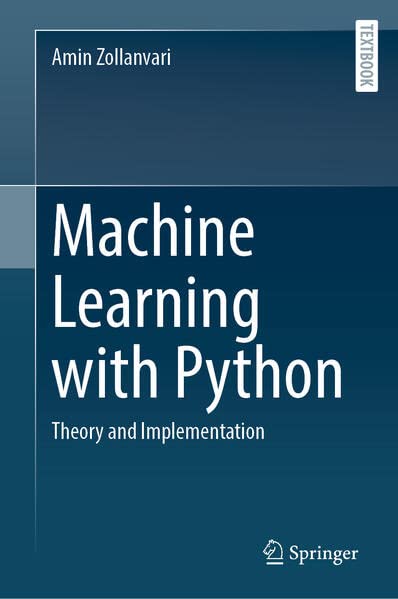

Machine learning with Python : theory and implementation / Amin Zollanvari
Publisher: Cham : Springer, 2023Description: xvii, 452 p. : : ill. ; 24 cmISBN:- 9783031333422
- 303133342X
- 9783031333415
- Q325.5 .Z864M 2023
| Item type | Current library | Collection | Shelving location | Call number | Status | Date due | Barcode | Item holds |
|---|---|---|---|---|---|---|---|---|
 หนังสือ
|
PIM Creative Learning Space Chaengwattana | หนังสือภาษาอังกฤษ | English Book Shelves | Q325.5 .Z864M 2023 (Browse shelf(Opens below)) | Available | 32550000518829 |
Collection: หนังสือภาษาอังกฤษ Close shelf browser (Hides shelf browser)


|


|

|

|


|


|

|
||
| Q183.4 .A44L 2018 Leading science and technology : India next? / | Q295 .S677 2012 Handbook of real-world applications in modeling and simulation / | Q325.5 G669M 2018 Machine learning : a constraint-based approach / | Q325.5 .Z864M 2023 Machine learning with Python : theory and implementation / | Q335 .L678A 2025 AI and innovation how to transform your business and outpace the competition with generative AI / | Q335 .L951 2009 Artificial intelligence : structures and strategies for complex problem solving / | Q335 .N353A 2018 Artificial intelligence / With an introduction to machine learning |
Includes bibliographical references and index
Preface -- About This Book -- 1. Introduction -- 2. Getting Started with Python -- 3. Three Fundamental Python Packages -- 4. Supervised Learning in Practice: The First Application Using Scikit-Learn. - 5. K-Nearest Neighbors -- 6. Linear Models -- 7. Decision Trees -- 8. Ensemble Learning -- 9. Model Evaluation and Selection -- 10. Feature Selection -- 11. Assembling Various Learning Stages -- 12. Clustering -- 13. Deep Learning with Keras-TensorFlow. - 14. Convolutional Neural Networks -- 15. Recurrent Neural Networks -- References
Available to OhioLINK libraries
This book is meant as a textbook for undergraduate and graduate students who are willing to understand essential elements of machine learning from both a theoretical and a practical perspective. The choice of the topics in the book is made based on one criterion: whether the practical utility of a certain method justifies its theoretical elaboration for students with a typical mathematical background in engineering and other quantitative fields. As a result, not only does the book contain practically useful techniques, it also presents them in a mathematical language that is accessible to both graduate and advanced undergraduate students. The textbook covers a range of topics including nearest neighbors, linear models, decision trees, ensemble learning, model evaluation and selection, dimensionality reduction, assembling various learning stages, clustering, and deep learning along with an introduction to fundamental Python packages for data science and machine learning such as NumPy, Pandas, Matplotlib, Scikit-Learn, XGBoost, and Keras with TensorFlow backend. Given the current dominant role of the Python programming language for machine learning, the book complements the theoretical presentation of each technique by its Python implementation. In this regard, two chapters are devoted to cover necessary Python programming skills. This feature makes the book self-sufficient for students with different programming backgrounds and is in sharp contrast with other books in the field that assume readers have prior Python programming experience. As such, the systematic structure of the book, along with the many examples and exercises presented, will help the readers to better grasp the content and be equipped with the practical skills required in day-to-day machine learning applications


There are no comments on this title.